PROJECT OUTPUT
Image Categorisation
Created an image classification pipeline for a 15-class scene dataset using Tiny Images, HOG, SURF Bag of Visual Words, ResNet18 transfer learning, LBP, Random Forest, KNN, SVM, CNN fine-tuning, and confusion matrix analysis.,
- SUN images
- 3000
- scene categories
- 15
- methods compared
- 5
WHAT I DID
Compared classical image features with deep learning.
The project uses a 3000-image subset of the SUN database across 15 scene categories. Each method extracts visual information differently, then a classifier predicts the scene category from those features.
- Prepared a balanced SUN scene dataset with 1500 training images and 1500 testing images.
- Built a baseline using Tiny Image features with KNN and SVM classifiers.
- Improved classical feature extraction with HOG, SURF Bag of Visual Words, and LBP texture features.
- Fine-tuned a pretrained ResNet18 model to compare deep transfer learning against handcrafted features.
- Evaluated each method using accuracy, confusion matrices, and training output to understand model performance.
RESULT
Accuracy comparison across the best version of each method
The table focuses on what matters for a portfolio reader: the feature method, classifier, accuracy, and what the result shows.
| Feature Method | Best Classifier | Accuracy | What It Shows |
|---|---|---|---|
| Tiny Image | KNN | 0.322 | Simple baseline, but compressed images lose important scene detail. |
| HOG | SVM | 0.503 | Edge and shape descriptors improved recognition over raw tiny pixels. |
| SURF BoW | SVM | 0.394 | Local visual words captured patterns, but were weaker than stronger feature sets. |
| ResNet18Best overall | CNN | 0.928 | Best result, using pretrained deep features for high-level scene understanding. |
| LBP | Random Forest | 0.551 | Strongest classical comparison, especially useful for texture-heavy scenes. |
INTERPRETATION
Better features produced better classification.
- The results show that feature quality had the biggest effect on classification performance.
- Classical methods became stronger when features described edges, texture, or local image patterns.
- ResNet18 performed best because transfer learning uses rich pretrained visual features.
- The comparison shows a clear progression from a simple baseline to advanced deep image classification.
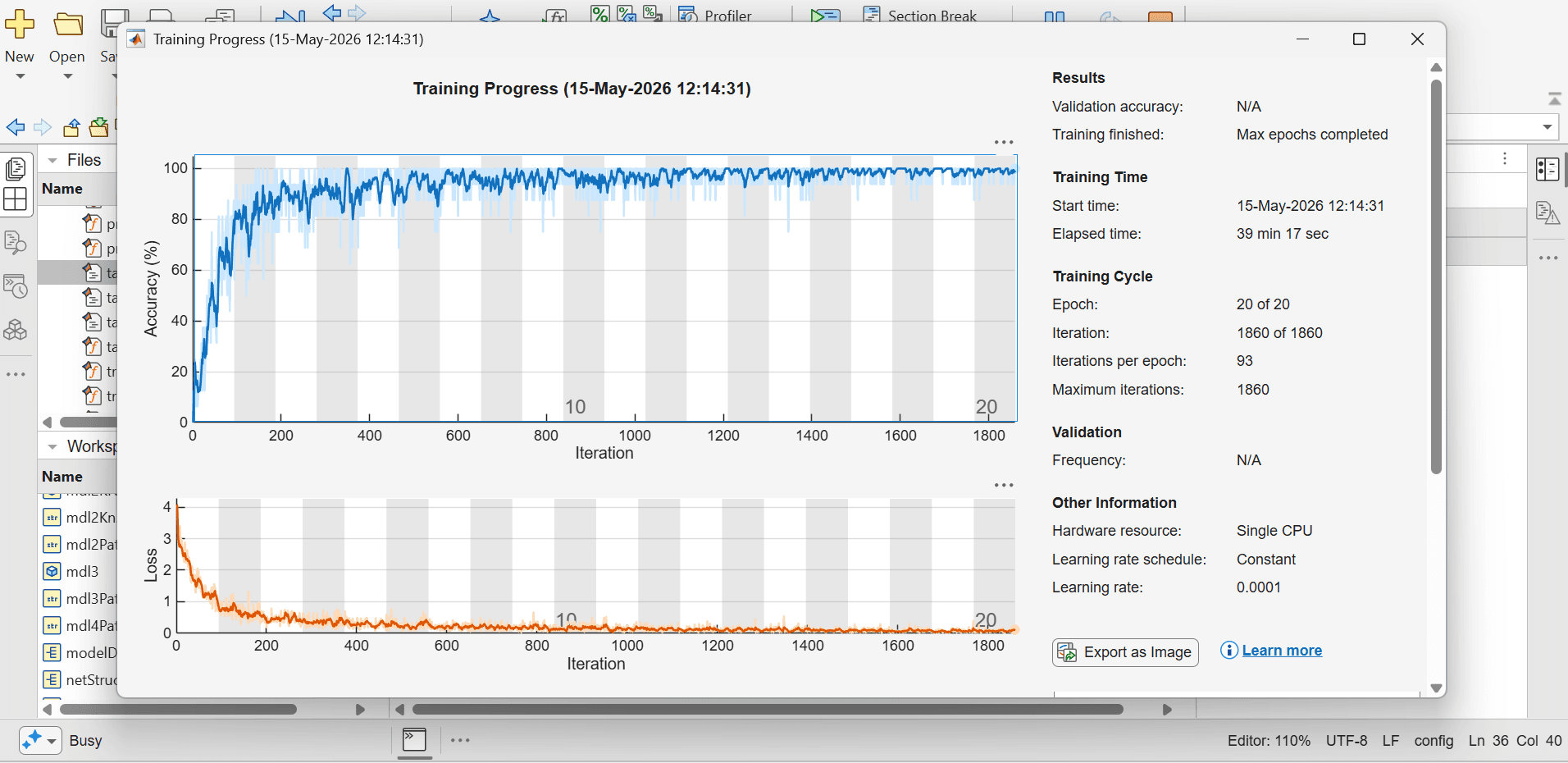
TRAINING OUTPUT
Model training progress
The training output provides supporting evidence from the deep learning experiment, showing how the model learned during the training cycle.